While foreign nationals can invest in certain sectors, Lesotho’s Constitution prohibits private ownership of land by anyone, and the country’s trade laws reserve numerous small-business sectors exclusively for Basotho citizens.
Nicole Tau
A Facebook post published in June 2026 by a public self-proclaimed news page with more than 71,000 followers claims that foreign nationals can simply register a business, “buy a site anywhere” in Lesotho, build residential houses like citizens and freely operate businesses ranging from hair salons to Japanese car dealerships without meaningful government regulation.
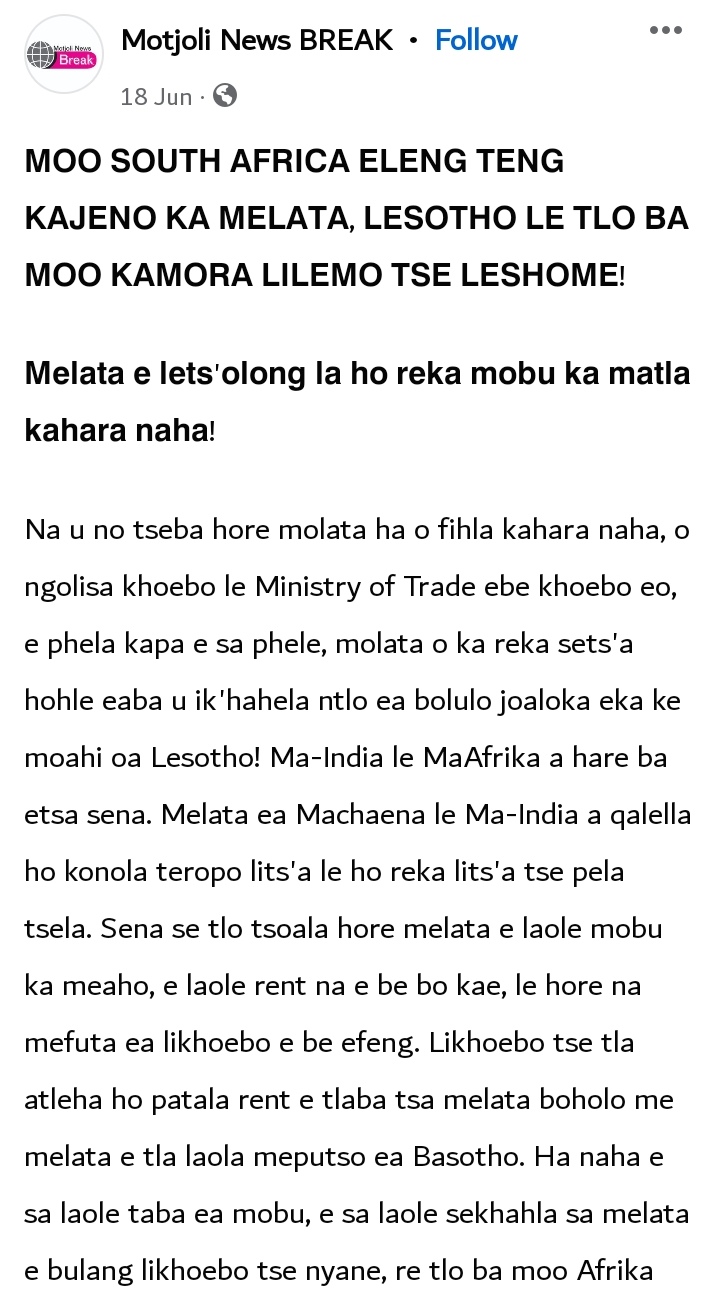
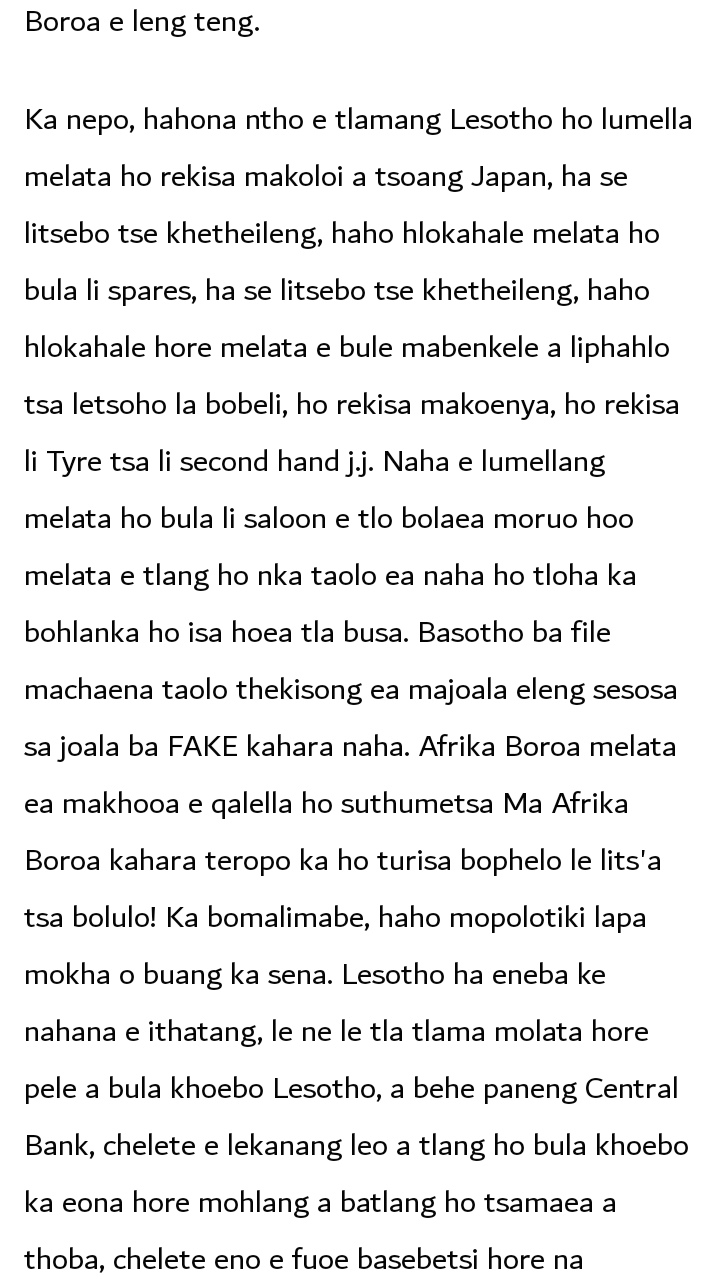
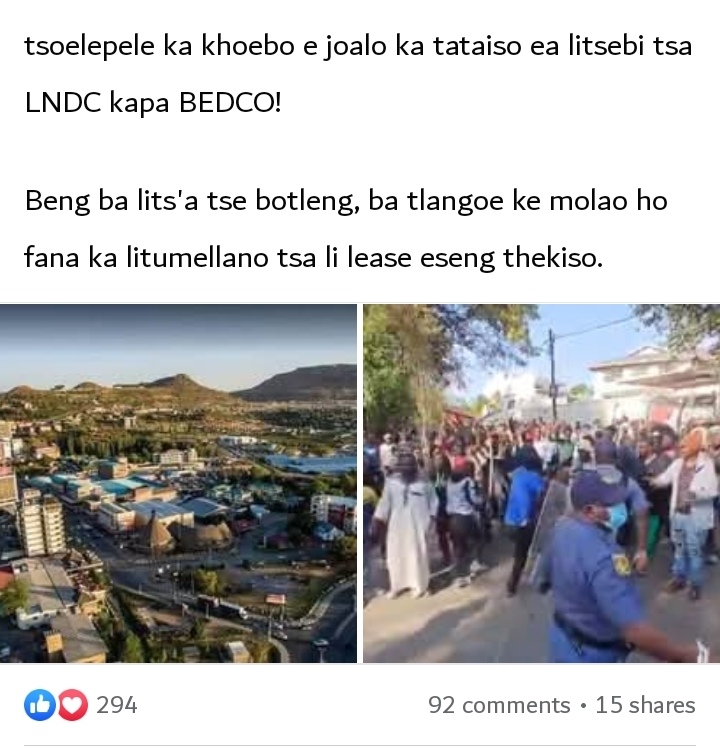
The post attracted at least 15 shares, amplifying concerns about foreign investment and local economic survival.
Because it touches on land ownership, small business competition and employment, issues that generate intense public debate in Lesotho, it has the potential to fuel xenophobic hostility toward foreign nationals, creating the false impression that they operate in a legal vacuum.
To verify these claims, CheckDesk began by reviewing the original Facebook post before tracing each legal assertion individually. Rather than relying on secondary reporting, we reviewed the Constitution of Lesotho, examined the Land Act of 2010, scrutinized the Business Licensing and Registration Act and its Regulations, and cross-referenced them with official guidance from the One-Stop Business Facilitation Centre (OBFC).
In the interest of fairness, a number of repeated attempts were made over several weeks to secure official statements from the Ministry of Local Government, the Ministry of Land, and the Land Authority through the Ministry of Trade. Despite being afforded their right to reply, these departments remained unresponsive, leaving the primary legal texts as the definitive proof in this audit.
Our investigation found the claim that a foreigner can “buy a site anywhere” as if they were a citizen is legally false and misrepresents how land ownership works in Lesotho.
According to Section 107 of the Lesotho Constitution (Chapter IX: Land), “all land in Lesotho is vested in the Basotho Nation.” The ultimate authority to allocate land rests not with private sellers, but is “vested in the King in trust for the Basotho Nation,” as mandated by Section 108 of the supreme law. This means land cannot be “sold” in an outright private transaction by either citizens or foreign nationals; it is held via state-regulated leaseholds.
Regarding commercial land access, Section 6 of the Land Act No. 8 of 2010 explicitly outlines the requirements for foreign enterprises. A foreign enterprise is legally permitted to hold a land title or lease for investment purposes, but only if Lesotho citizens hold at least a 20% shareholding or membership in the enterprise.
Where the viral post misleads the public is in claiming that individual foreign nationals can simply purchase land freely on their own terms. Individual foreign ownership outside of the statutory 20% local partnership framework (or explicit ministerial approval) remains unlawful. Where foreign individuals occupy or build on land independently without local participation, it is typically through illegal informal arrangements, rather than statutory compliance.
The narrative of unregulated foreign entry into small-scale retail is also directly contradicted by statutory law.
Under the Business Licensing and Registration Act, 2019, and its Business Licensing and Registration Regulations, 2020, unlike Basotho citizens, foreign nationals seeking to establish a commercial enterprise must first obtain a Business Permit, even before legally operating.
Foreign applicants must also demonstrate that their investment will create employment for at least six Basotho citizens and facilitate technology or skills transfer.
Crucially, the law establishes an explicit Reserved Business List that prohibits foreign nationals from operating in micro and small-scale sectors reserved exclusively for Basotho. Contrary to the post’s claims, this reserved list specifically protects:
- Hair salons and barber shops
- Secondhand clothing retail (liphahlo tsa letsoho la bobeli)
- Street vending and informal food sales (makoenya)
- Retail of secondhand motor vehicles and spare parts
- Small grocery outlets and butcheries
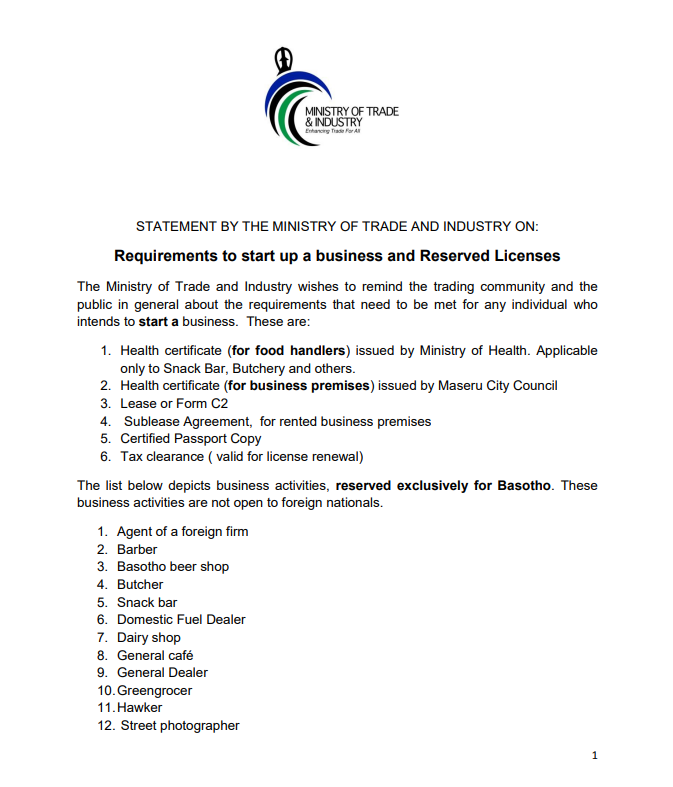
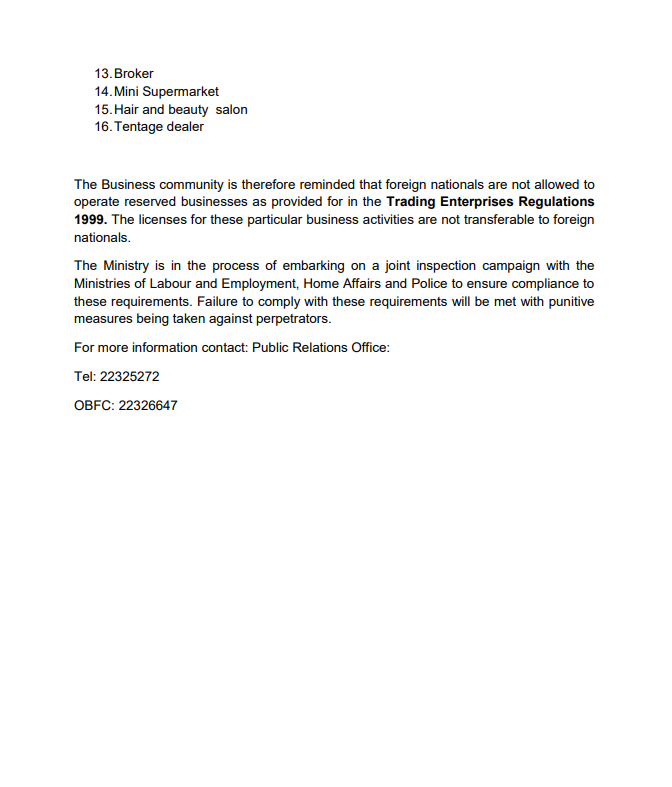
Importantly, the enforcement provisions are non-discriminatory: for any entity or individual found in breach, whether an unauthorized foreign operator or a local Basotho citizen engaging in illegal fronting or unauthorized license sub-leasing, the Ministry specifies administrative fines ranging from M50,000 to M100,000, alongside license or registration revocation.
The stated objective of these laws is to provide Basotho entrepreneurs the space to grow “without fear of facing stiff competition from foreign firms”. While foreign operators do exist in these spaces, their presence is an issue of regulatory enforcement and inspection capacity, not an absence of protective laws.
The post’s secondary assertion, that foreign liquor sales are the root cause of counterfeit alcohol (joala ba fake) in the country, is unproven. According to the Africa Organised Crime Index 2025 report, the rise in counterfeit tobacco and alcohol in Lesotho is primarily fueled by higher tax levies, local unregulated distilleries, and smuggling operations linked to South African and Chinese criminal networks. While porous borders and weak customs enforcement enable tax-evasion schemes like cigarette roundtripping, the document attributes counterfeit distribution to these cross-border criminal networks rather than retail shop ownership by a specific nationality.
Finally, the claim that “no politician or political party is talking about this” is false. Indigenization of the economy and local business protection are among the most frequently debated topics in Parliament. In fact, the passage of the Business Licensing and Registration Act in 2019 was the direct result of parliamentary pressure to protect local traders.
The Facebook post presents a partial truth wrapped in significant misinformation. While Lesotho faces genuine enforcement challenges regarding illegal fronting and informal retail inspection, the assertion that the country lacks laws regulating foreign land acquisition and small business operation is factually incorrect.
Unchecked claims of this nature risk inflaming xenophobic sentiment by creating the false impression that foreigners operate entirely outside the law. The legal framework demonstrates otherwise.
This fact-check was produced by Nicole Tau, CheckDesk at MISA Lesotho, as part of the African Fact-Checking Alliance’s (AFCA) incubation programme. It was produced with peer mentorship from Code for Africa’s fact-checking initiative, PesaCheck, with financial support from Norway Democracy. AFCA mentorship respects the journalistic independence of the researchers, offering access to advanced techniques and tools, while editorial decision-making remains with MISA Lesotho. Want to learn more? Visit: https://factcheck.africa/