Nicole Tau
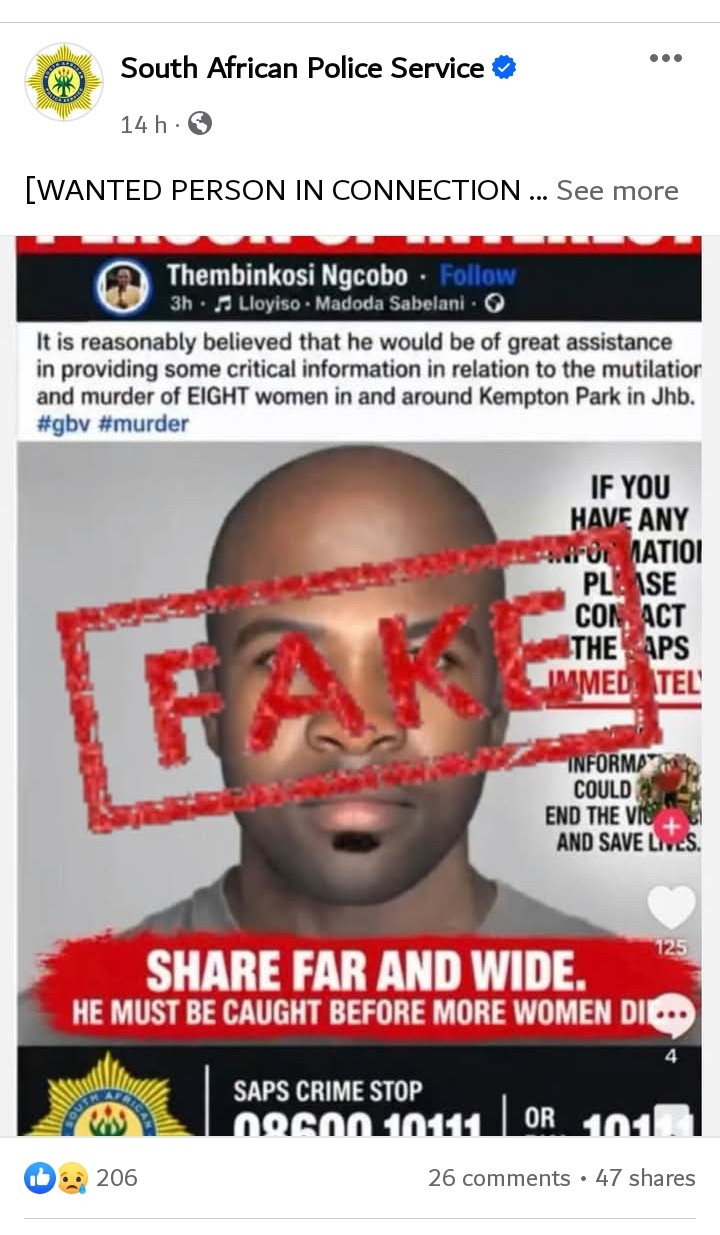
On September 15, an image circulated on Facebook as that of a man allegedly wanted in connection with the deaths of eight women in and around Kempton Park. However, the post falsely links the image to the Ekurhuleni investigation.
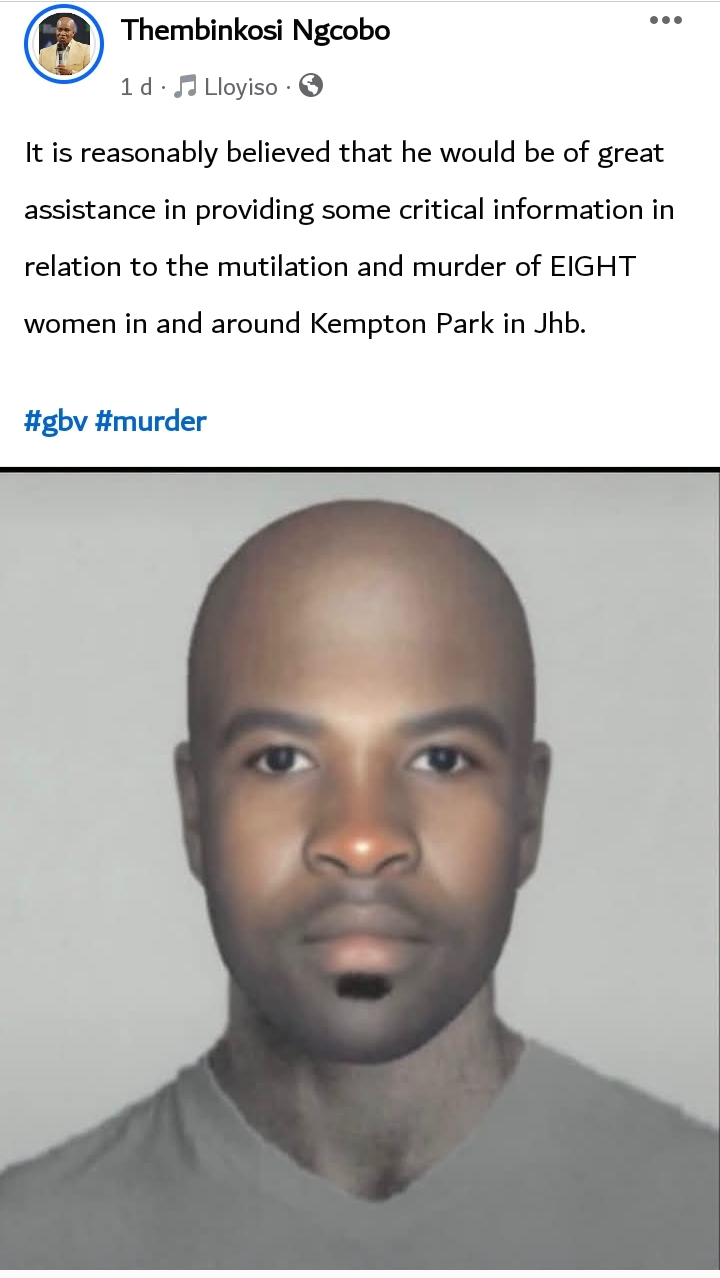 The image was shared alongside a post presenting the man as a person sought to provide some critical information in connection with the high-profile investigation into the deaths of women in Ekurhuleni.
The image began circulating as the South African Police Service (SAPS) intensified investigations into a series of women’s deaths across Ekurhuleni.
Between July and mid-September, SAPS investigated the discovery of four women’s bodies in the Kempton Park area. On 12 September, SAPS officially acknowledged the deaths, noting similarities between the cases.
The following day, 13 September, Acting Gauteng Provincial Commissioner Major General Fred Kekana established a multidisciplinary team to examine potential connections, emphasizing that police were exploring all possibilities rather than limiting themselves to one suspect.
By 17 September, the scope widened further when the discovery of a victim in Dawn Park, Boksburg, brought the total number of bodies recovered in the district to nine.
It was in the midst of this active, high-profile investigation, that the false post featuring the image of a wanted man, was published.
Following a reverse search, CheckDesk found that the image comes from a genuine South African Police Service (SAPS) public appeal involving a separate case in Dobsonville, Soweto.
On 16 September 2026, SAPS explicitly warned the public against the false linkage, saying the circulating photograph was connected to a rape case reported in Dobsonville on 1 September 2026, not to the investigation into the deaths of eight women in Ekurhuleni. SAPS also said it had not released a photograph or identikit of a suspect in connection with those deaths.
CheckDesk also established that the original notice was issued by the Johannesburg District Family Violence, Child Protection and Sexual Offences (FCS) Unit, which appealed to the public for assistance in identifying and locating a person of interest who could assist with an investigation into a rape reported in Dobsonville on 1 September 2026.
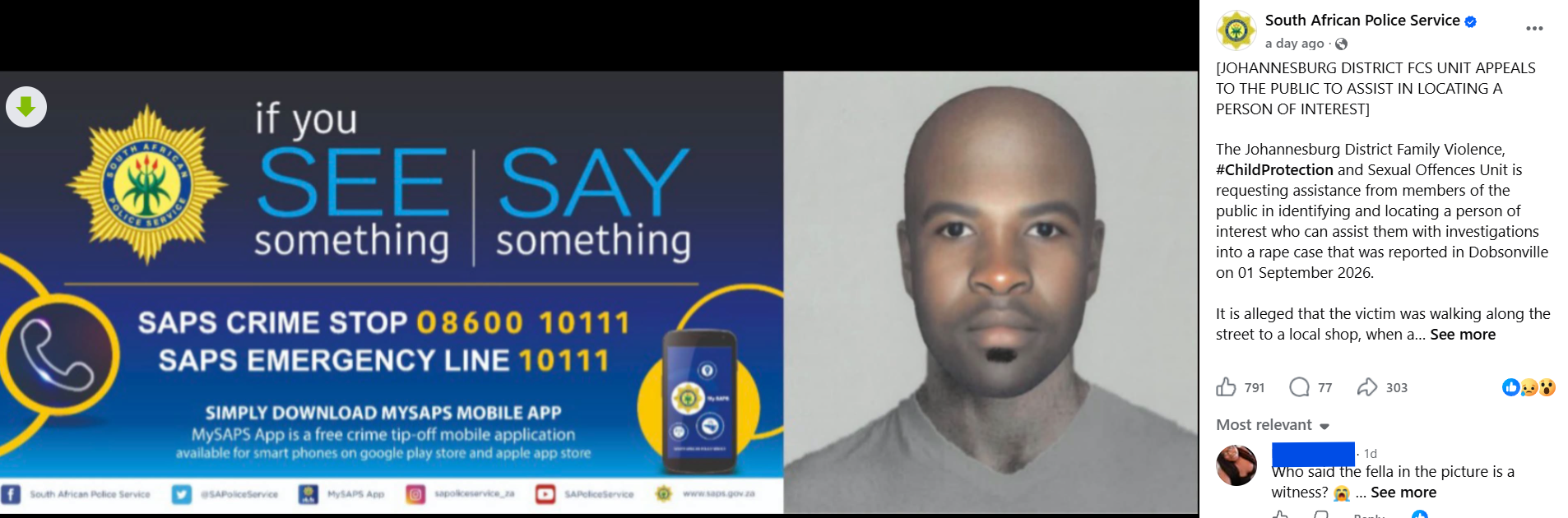
According to the notice, the incident involved a woman who was allegedly approached while walking to a local shop by three unknown men travelling in a white Toyota Quantum. One of the men allegedly forced her into the vehicle before she was taken to an unknown open area and raped. Police said the person shown in the photograph may have information that could assist with the investigation.
This established an important distinction: the photograph itself was genuine, but the claim attached to it was not.
SAPS subsequently clarified that the image circulating online was not that of a person being sought in connection with these deaths. The police service urged members of the public to be cautious about sharing unverified information that could wrongly identify people.
The post illustrates how authentic material can be turned into misinformation simply by changing its context. The photograph did originate from SAPS who were genuinely asking for the public’s assistance in locating the person pictured. However, the original notice concerned a Dobsonville rape investigation, not the deaths of women in Ekurhuleni, whose tally now stands at 12.
This distinction is important: a person described by police as a person of interest is not necessarily a suspect, and an image published in connection with one investigation cannot be assumed to relate to another simply because the timing and location appear similar.
Why the false identification is dangerous
The Ekurhuleni deaths have generated fear and intense public attention. Police have warned against unverified information and have asked the public to provide credible information through official channels (such as the Crime Stop Line at 08600 10111 or the MySAPS App).
Misidentifying a person in a high-profile murder investigation can have serious consequences.
- It can expose an unrelated person to harassment, threats or mob violence, interfere with an active police investigation, and divert public attention from information that investigators actually need.
- It can also make genuine police appeals harder to assess because members of the public may begin treating social-media posts as extensions of official police communication.
The verdict
Although the image is genuine, the claim that the man pictured in a SAPS notice is connected to the murder of eight women in the Ekurhuleni murder case is FALSE. Although three suspects have been identified, SAPS has not released a photograph or identikit of a suspect in those killings.
This fact-check was produced by Nicole Tau, CheckDesk at MISA Lesotho, as part of the African Fact-Checking Alliance’s (AFCA) incubation programme. It was produced with peer mentorship from Code for Africa’s fact-checking initiative, PesaCheck, with financial support from Norway Democracy. AFCA mentorship respects the journalistic independence of the researchers, offering access to advanced techniques and tools, while editorial decision-making remains with MISA Lesotho. Want to learn more? Visit: https://factcheck.africa/