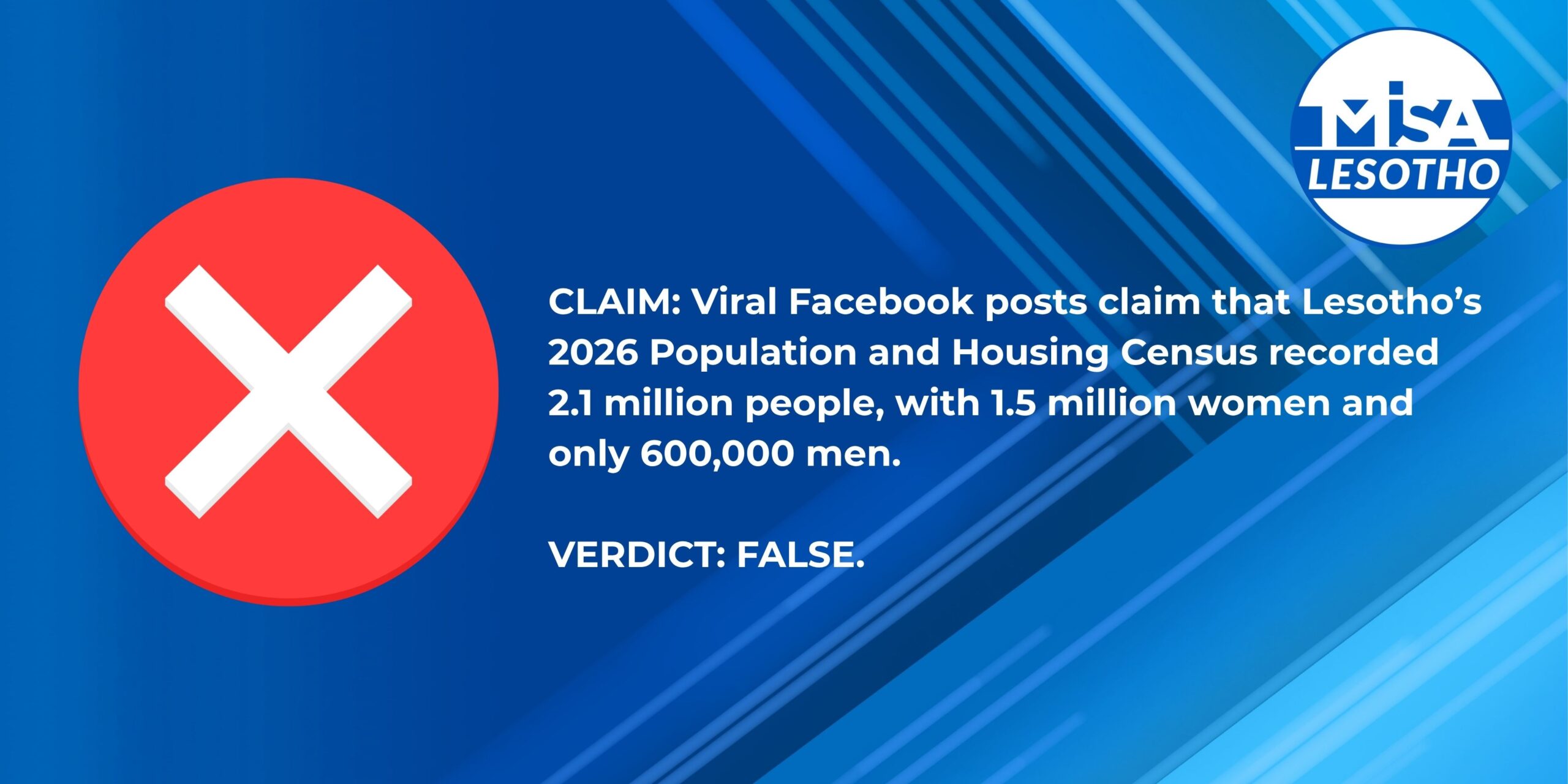
The circulating figures are unverified, demographically inaccurate, and do not originate from official data.
Nicole Tau
A viral Facebook post claiming that Lesotho’s 2026 Population and Housing Census recorded a population of 2.1 million people, including 600,000 men and 1.5 million women, is circulating widely on social media.
However, the post’s claim is false. The Bureau of Statistics (BoS), the only institution mandated to produce official census data in Lesotho, has not released any official results for the 2026 Population and Housing Census and says no census report has been released and the figures circulating online do not reflect verified data.
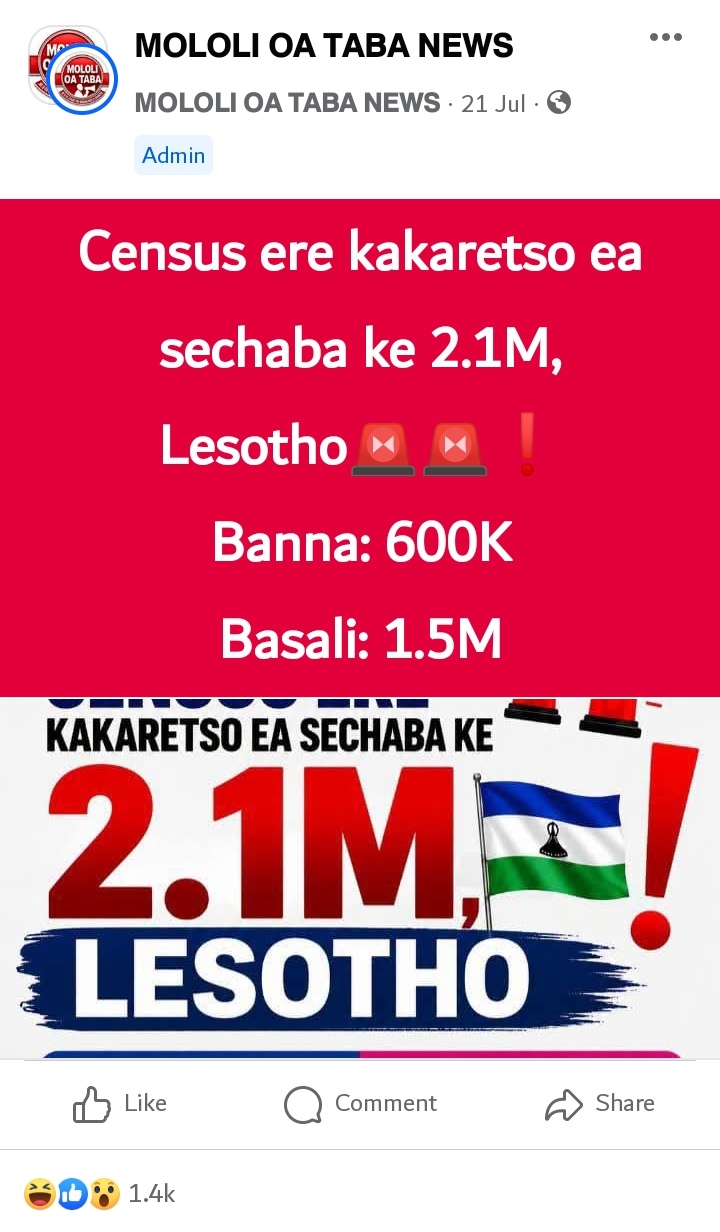
On 21 July 2026, the post, published by the Facebook page Mololi Oa Taba News, stated:
“Census ere kakaretso ea sechaba ke 2.1M, Lesotho🚨🚨❗️ Banna: 600K Basali: 1.5M”
(Translated: “Census says the total population of the nation is 2.1M, Lesotho. Men: 600K, Women: 1.5M”)
The post attracted about 1,400 reactions and 149 shares, before being republished by Mohalalitoe Daily News, where it received around 1,700 reactions and 675 shares, significantly increasing its reach.
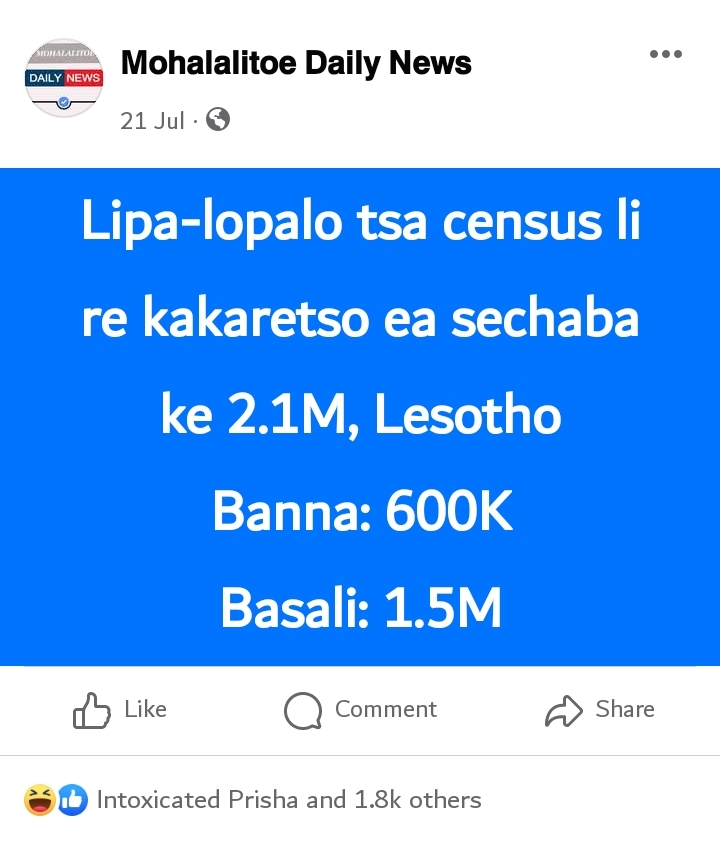
Although the post did not state a year, its active present tense phrasing “Census ere…” combined with its timing, directly implied that these were the official results of the ongoing 2026 Population and Housing Census.
Because the figures were presented as official census results, CheckDesk sought to verify whether the Bureau of Statistics had in fact published the 2026 Population and Housing Census.
CheckDesk archived the original Facebook posts and reviewed official communications from the Bureau of Statistics. We also contacted the Bureau directly to confirm whether the 2026 census results had been released or leaked.
The Bureau confirmed that the census is still undergoing verification and that no official report has been released.
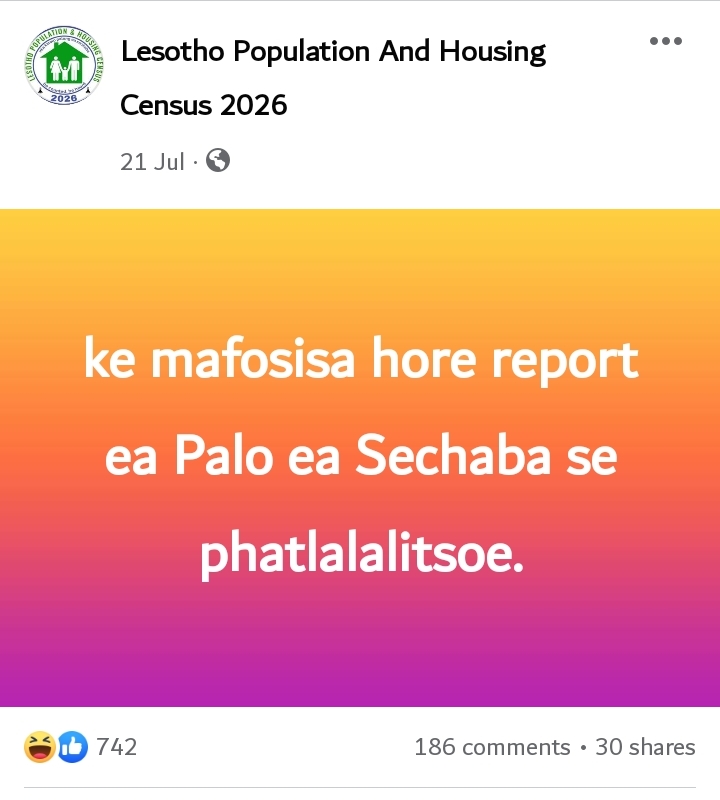
On its official Facebook page, the Lesotho Population And Housing Census 2026 dismissed the circulating claims, stating: “ke mafosisa hore report ea Palo ea Sechaba se phatlalalitsoe.” Translated, this means: “It is false that the Population Census report has been published.”
A separate official notice issued by the Bureau, about a week earlier, on 15 July 2026, further confirms that the census process is still ongoing. The notice announced the start of a verification and validation exercise, which involves revisiting selected households to confirm and correct data collected during the census.
The notice stated that:
- The exercise is conducted by permanent Bureau of Statistics staff
- It ensures data accuracy, completeness, and quality
- It is a standard statistical quality assurance process
- Information collected remains confidential under the Statistics Act (2001)
This means that, as of the time of the post, the census data is still being reviewed and has not yet been finalised for publication.
Speaking to CheckDesk, the Bureau’s Public Relations Officer, Neo Mokatsa, confirmed that the institution has not released any census results.
She also stated that the figures circulating online do not resemble the data currently under verification.
“The report is still in the verification process. We do not even have the final draft report yet, so these cannot be official results,” she said.
She added that the Bureau has not been able to trace the origin of the circulating figures and has attempted, without success, to contact the page that published them.
According to the Bureau, the reported ratio of 600,000 men to 1.5 million women is also a strong indication that the figures are not based on verified demographic data.
“The ratio alone shows it was produced without demographic knowledge. Statisticians know that such a distribution is highly unlikely,” she said.
According to the official 2016 Lesotho Population and Housing Census: Summary of Key Findings, published by the BOS, Lesotho’s total population stood at 2, 007,201. Of that total population, 982, 133 were male (48.9%) and 1,025, 068 were female (51.1%), representing an overall sex ratio of 95.8 males per 100 females.
In 2016, the gap between men and women in Lesotho was approximately 42, 935. Yet the viral post claims that the male population has dropped to 600,000 while the female population has surged to 1,5 million, representing an impossible demographic shift in a 10-year intercensal period.
The Bureau further warned that the spread of false census figures could undermine public trust in official statistics once the final report is released.
“When the official report is eventually released, people will compare it with these false figures. We need Basotho to trust the process,” she said.
The Bureau explained that census data goes through multiple stages, including cleaning, validation, and quality assurance, before publication. Once complete, the final results will be formally released to the public.
Although false, the post generated significant engagement. Many Facebook users questioned the figures, particularly the claim that women outnumber men by nearly one million.
Others expressed confusion over why Lesotho’s population appears to have changed very little compared to previous censuses, while some assumed the figures were credible because they were widely shared by multiple pages.
A key factor in the spread of such claims is the role of Facebook-based “news pages” that operate without clear editorial structures or publicly verifiable accountability mechanisms. While these pages often present themselves as news sources and attract large followings, they are not always registered media organisations, and their administrators are not easily identifiable. In this case, the Bureau of Statistics also indicated that it was unable to trace or formally contact the page that published the claim, highlighting the challenge of verifying and correcting misinformation once it spreads through such platforms.
However, the Bureau of Statistics has not released any official figures, and social media circulation does not make the data authentic.
As of 29 July 2026, the 2026 Population and Housing Census is still undergoing verification and validation. No official results have been published.
Any social media post claiming to present final census figures is therefore false and misleading.
This fact-check was produced by Nicole Tau, CheckDesk at MISA Lesotho, as part of the African Fact-Checking Alliance’s (AFCA) incubation programme. It was produced with peer mentorship from Code for Africa’s fact-checking initiative, PesaCheck, with financial support from Norway Democracy. AFCA mentorship respects the journalistic independence of the researchers, offering access to advanced techniques and tools, while editorial decision-making remains with MISA Lesotho. Want to learn more? Visit: https://factcheck.africa/