Nicole Tau
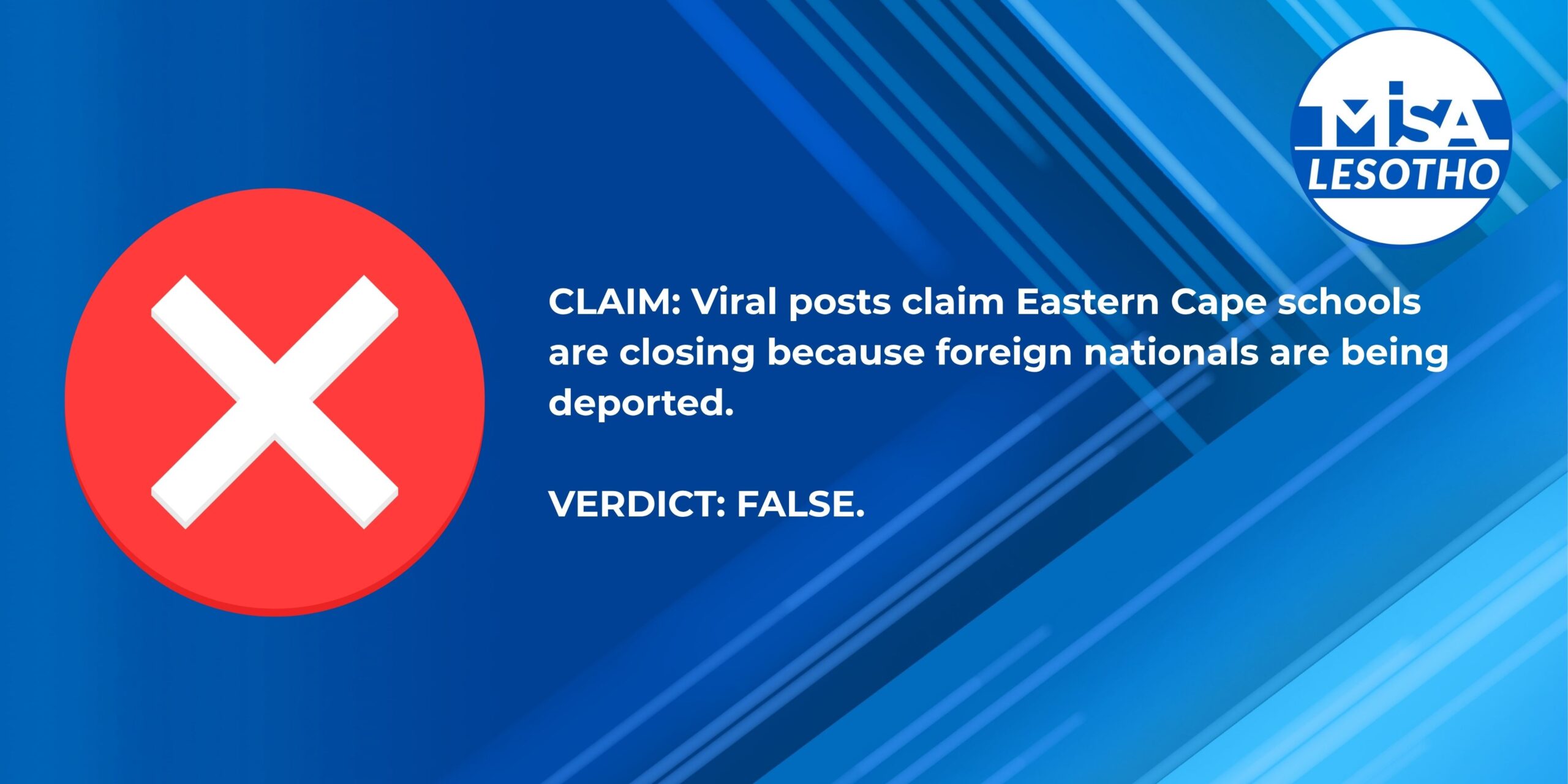
A video on Facebook with a caption claiming that schools in South Africa’s Eastern Cape are closing because foreign nationals are being deported is false.
The video, which is seemingly from legitimate news footage, carried the text: “Eastern Cape Schools closing down because foreigners are deported.”

The post received approximately 6,900 reactions
and 456 shares, helping spread the claim further
to a larger audience.
CheckDesk verified that the footage originated from an authentic Newzroom Afrika broadcast published on 9 August 2026. The original report addressed the Eastern Cape Department of Education’s decision to rationalise and close 123 under-enrolled schools.
 The broadcast made no mention of immigration enforcement, nor did it attribute declining learner numbers or school closures to deportations or the departure of foreign nationals.
In the original report, Newzroom Afrika featured the Eastern Cape Department of Education’s plans to close 123 schools, with hundreds more potentially affected in the coming years.
Department spokesperson Malibongwe Mtima explained that schools with very low enrolment can become operationally and financially unviable because resources, including educators, are allocated largely according to learner numbers.
The report did not link the closures to immigration enforcement or deportations.

A separate Newzroom Afrika report published on YouTube the same day featured an education advocacy non-governmental organisation Equal Education, which argued that the issue was more complex. The organisation said poor infrastructure and other longstanding challenges in rural schools may have contributed to parents moving their children to better-resourced schools.
The closures have also raised concerns about consultation with communities, scholar transport and the longer distances some children may have to travel.
National education data also provides no evidence to support the viral narrative. In a written parliamentary response published in February 2026, South Africa’s Department of Basic Education said that foreign learners accounted for 1.8% of the country’s total learner population, while 98.2% were South African citizens. The department said the claim that foreign learners were “overrunning” schools or were the primary cause of pressure on the education system was not supported by the available evidence.
In a separate television interview from January 2026, the Department of Basic Education’s spokesperson, Terrence Khala, said South Africa’s basic education system had more than 13.7 million learners and that foreign learners represented between 1.8% and 2% of the total learner population. The figures are consistent with data cited in the parliamentary response, which reported 253,680 foreign learners in the state school sector in 2025.
However, these national figures do not by themselves show how many foreign learners were enrolled in the specific Eastern Cape schools identified for closure, or whether changes in their numbers contributed to declining enrolment at those schools.
Available evidence about the closures points directly to demographic shifts in a province where most of the population lives in rural areas. Reporting published by The Herald on 8 September 2025 “Bhisho pressing ahead with closure of unviable rural schools” details the school rationalisation and realignment programme managed from Bhisho, the capital city of the Eastern Cape.
Joseph Varkeychan, the department’s Chief Director of Resourcing and School Administration, explicitly explained the reason for declining enrolment:
“The main reason for diminishing numbers at rural schools was families migrating to cities or other provinces.”
This long-standing provincial process directly refutes the viral narrative and establishes that the rationalisation programme is not a sudden reaction to recent deportations. According to reports, over 1,000 unviable rural schools in the Eastern Cape have been closed or merged since 2017.
The claim is particularly misleading because it uses authentic news footage. Viewers may recognise the Newzroom Afrika branding and assume that the text above the video reflects what the broadcaster reported.
However, as Checkdesk established, parliamentary records from the Department of Basic Education, official departmental disclosures reported in local media, and historical evidence confirm that the closures are part of a long-running school rationalisation programme initiated nearly a decade ago to address dwindling rural enrolment caused by internal migration to urban areas and other provinces.
This fact-check was produced by Nicole Tau, CheckDesk at MISA Lesotho, as part of the African Fact-Checking Alliance’s (AFCA) incubation programme. It was produced with peer mentorship from Code for Africa’s fact-checking initiative, PesaCheck, with financial support from Norway Democracy. AFCA mentorship respects the journalistic independence of the researchers, offering access to advanced techniques and tools, while editorial decision-making remains with MISA Lesotho. Want to learn more? Visit: https://factcheck.africa/