Nicole Tau
A video (archived here) shared on Facebook claims to show a South African woman physically assaulting the owner of a foreign-run spaza shop, an informal township grocery store, during an argument over business licenses and regulatory compliance.
In the viral clip, the woman appears to punch the man in the gut before slapping him across the face.

The video, posted on 14 August 2026, accumulated more than 7,400 reactions and 849 shares.
The caption accompanying the video reads in part:
“YOU CAN’T CLEAN A HOUSE BY SETTING IT ON FIRE. ‘Fixing the country’ cannot mean assaulting people on camera… That video of a SA woman allegedly slapping a foreign shop owner proves one thing: frustration is high, but so is the risk of losing our values. Crime must be met with due process. Not slaps. Not mobs. Not xenophobia.”
However, CheckDesk found that the video is ALTERED.
To verify the origin and authenticity of the clip, CheckDesk conducted a visual and open-source intelligence (OSINT) investigation.
The process began with keyframe extraction from the viral video, followed by a Google Reverse Image Search. This search uncovered unedited, authentic recordings of the incident that had been published by online media platforms prior to the August 14 viral post.
To establish the primary source and exact context, CheckDesk then tracked the digital footprint and social media activity of the “March March” movement. This analysis identified the woman in the video as Azola Mrano, Eastern Cape Leader of March March. The incident took place on 7th August, in Mdantsane, Eastern Cape, during a “10-day campaign”, led by Mrano.
While the full raw footage was not posted directly on Mrano’s personal Facebook page, cross-referencing a video she shared from other media outlets confirmed the event’s location and participants.
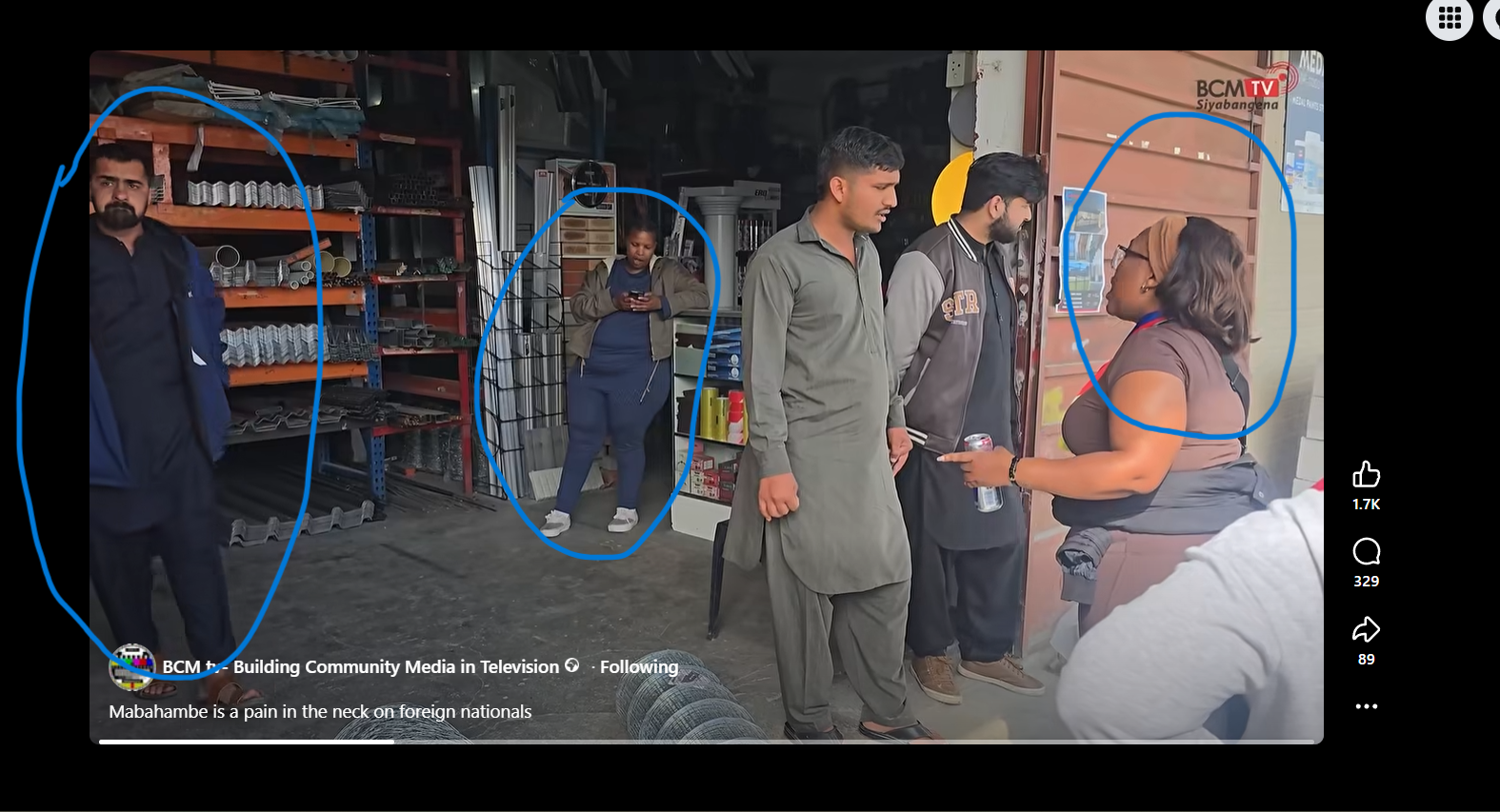
Distinct visual anchors, including the man from the original video and a store employee, are both present in the original and manipulated clips, as well as physical setting, all matched across all videos.
Multiple recordings of the event, shared on various social media pages, confirm that the confrontation was strictly verbal. Across all verified footage of the incident, Mrano demands regulatory documentation from the store’s worker without making physical contact at any point, proving that the alleged physical assault was synthetically fabricated.
Primary AI Indicator
The most definitive indicator of artificial intelligence manipulation in the viral video is the profound synchronization failure between the audio track and the visual lip movements. While the authentic audio recording of the verbal exchange was retained, the visual sequence was altered to depict physical violence, creating a clear mismatch where the spoken words do not correspond with the subject’s mouth movements.
This audio-visual desynchronization serves as the primary technical hallmark of synthetic fabrication. As detailed by Adaptive Security in How to Detect Deepfake AI Videos , audio-visual synchronization failure represents the “most durable combined tell” when identifying deepfakes and altered media. Because individual audio and video generation tools are evolving faster than the underlying temporal sync technology, these timing discrepancies remain the most reliable diagnostic indicator for uncovering digitally manipulated content.
Risk of Inciting Real-World Violence
The circulation of fabricated violence occurs amidst heightened social tensions in South Africa surrounding non-citizen business ownership, informal food safety standards, and citizen-led compliance inspections.
Manipulating authentic recordings to depict physical violence, even when framed alongside a caption advocating for law and order, runs the grave risk of validating anti-immigrant narratives, stoking public anger, and inciting real-world retaliatory violence or vigilante action against foreign nationals.
The video claiming to show EC March March leader Azola Mrano, physically punching and slapping a foreign shop owner is digitally manipulated. The authentic recording shows a verbal argument regarding business compliance, with no physical assault taking place.
This fact-check was produced by Nicole Tau, CheckDesk at MISA Lesotho, as part of the African Fact-Checking Alliance’s (AFCA) incubation programme. It was produced with peer mentorship from Code for Africa’s fact-checking initiative, PesaCheck, with financial support from Norway Democracy. AFCA mentorship respects the journalistic independence of the researchers, offering access to advanced techniques and tools, while editorial decision-making remains with MISA Lesotho. Want to learn more? Visit: https://factcheck.africa/