By Nicole Tau
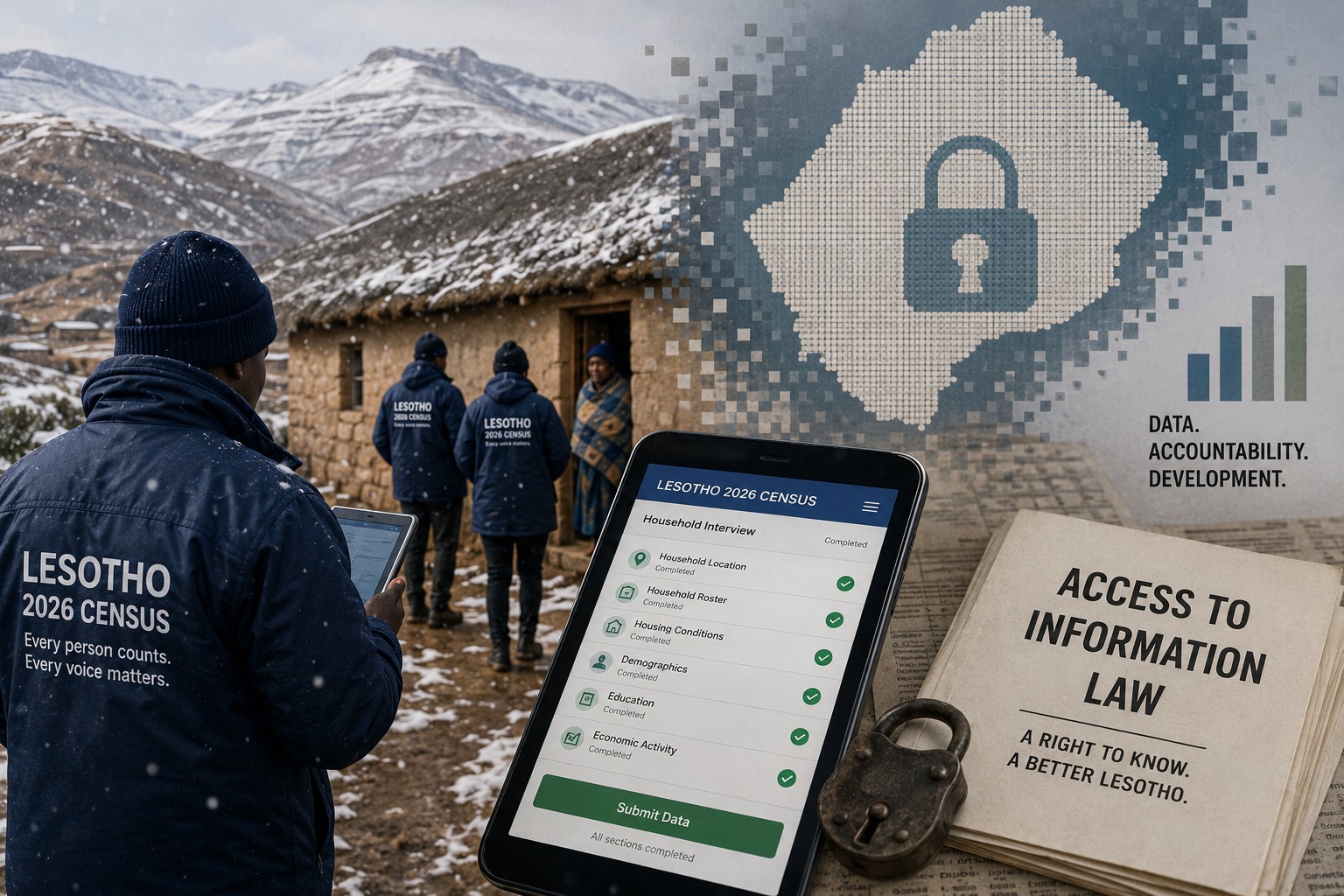
In the mountain highlands of Lesotho, young men and women recently moved door-to-door through snowfall and rain, carrying hand-held electronic tablets that hold the secrets of a nation’s future. This was the front line of Lesotho’s 2026 Population and Housing Census, a “fully digital” undertaking designed to ensure that for the first time in a decade, every Mosotho is finally visible to the state.
Yesterday, the focus shifted from the headlines to the Lehakoe Recreation and Cultural Centre in Maseru. There, government officials and stakeholders, including MISA Lesotho, gathered for a Census Stakeholder Meeting to conclude the data collection phase.
It was during this event that Dr. Retselisitsoe Matlanyane, the Minister of Finance and Development, responsible for statistics, delivered a blunt warning about what those digital tablets had captured. While the data is “very telling,” she admitted that the story it reveals is “not too good”.
The meeting also exposed a startling statistical anomaly that should have made the room pause: the count has reached 135% of the households the government actually expected to find. This discovery highlights the “monumental task” of tracking a population that has evolved far beyond the state’s old maps.
But as the “Lipitso” (traditional gatherings) of 1936 are replaced by the pixels of 2026, a deeper question remains: if the news is “not too good,” will the public be granted the legal right to see the evidence?
The technological triumph celebrated at the Lehakoe center masks a legislative void. While the tools are 21st-century, the legal framework in Lesotho for accessing this data remains rooted in the Statistics Act of 2001.
The Kingdom of Lesotho currently lacks a specific law on Access to Information (ATI), leaving the Bureau of Statistics (BOS) as the sole gatekeeper of the nation’s digital “master file”.
The 2001 Act is built on a foundation of secrecy. Section 23 and Section 26 of the law threaten employees with fines of up to M10,000 or five years in prison for publishing information “without lawful authority”.
While intended to protect privacy, in a country without an ATI law, these provisions create a culture of silence where data is only shared “aligning with what the law says we should share”.
This gap is a direct challenge to Section 14 of the Lesotho Constitution, which guarantees the “freedom to receive ideas and information without interference”.
The paradox was clear at the stakeholder meeting. Dr. Matlanyane could see the “telling” results, but the public must wait until August 2026 for a preliminary report, and March 2027 for the final datasets.
Without a law to operationalize the “Right to Know,” journalists are most possibly left with government-sanitized summaries rather than the raw data needed to investigate why the results are “not too good.”
When asked about structural Open Data strategies, the Director of the BOS, pointed to the 2001 Act as a defensive wall. Citing the ‘private information’ of citizens, she claimed the Bureau is restricted to sharing only 10% of census data with researchers, a limit not found in the text of the law itself. Her visible frustration at the end of the exchange underscored the growing friction: Lesotho has the digital tools to count its people, but its leaders are still searching for the legal language to trust those people with the results.
There is also the matter of the messengers. As observed by MISA Lesotho during the proceedings, the media sector often lacks the specialized training to interrogate complex “census master files” or navigate “tabulation plans”.
While the BOS Act mandates the Bureau to “provide guidance and training to other users of statistics,” the meeting emphasized a desperate need for workshops that go beyond “hype and awareness”.
Journalists need the skills to translate “cross-tabs” and “outliers” into stories that hold institutions accountable for the 135% of households they didn’t know existed.
The 2026 Census has proven that Lesotho can master the logistics of a digital nation. The tablets have been collected; the “outliers” are being verified.
But a digital census in a legal vacuum is a one-way conversation. As the final datasets are prepared for archiving next March, the real test will be whether the citizens who opened their doors to enumerators are granted the legal tools to see the results.
Without an ATI law and a data-literate press, the “Pixels” of 2026 risk becoming just as inaccessible as the paper records of 1936.
…………………………………………………………………………………………………………………………………………………………………………………………………….
Quick Facts: Lesotho 2026 Digital Census
- Preliminary results are expected to be released in August 2026.
- The count successfully reached 135% of projected households, suggesting previous data frames significantly underestimated the population
- The full results and the anonymized dataset for public use are scheduled for release by March 2027.
- Only 0.1% of the population refused to be counted.
- Approximately 12% of the housing stock was found to be vacant during the count.
- This was Lesotho’s first census to move entirely away from paper, using hand-held tablets and a real-time dashboard for data transmission